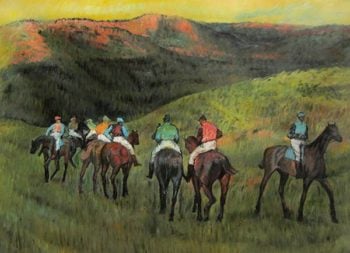
Biography ofJohn
Constable
John Constable was an English painter
who was a master of landscape painting in the romantic
style. His works, done directly from nature, influenced
French painters of the Barbizon School and the impressionist
movement.
Constable was born June 11, 1776, in East Bergholt,
Suffolk. He worked in his father's flour mill before
going to London in 1799 to study at the Royal Academy
schools. He exhibited his first landscape paintings
in 1802 and thereafter studied painting and English
rural life on his own, developing a distinctly individual
style.
His paintings, executed entirely in the open air rather
than in a studio, as was customary, were an innovation
in English art. Constable departed from the traditions
of Dutch and English painting by discarding the usual
brown underpainting and achieving more natural, luminous
lighting effects through the use of broken bits of color
applied with a palette knife.
He endeavored to portray the effect of the scene, often
softening physical details. He was fascinated by reflections
in water and light on clouds. Although he lived in London,
he painted the country around the Stour River in Suffolk
and in Salisbury and Dorset. For many years Constable
received little recognition or support in England.
In France, however, where his famous Hay Wain (1821,
National Gallery, London) was shown by a French dealer
at the Paris Salon of 1824, he was much admired by the
romantic painter Eugene Delacroix, by the Barbizon painters,
who began to paint outdoors, and by the impressionists,
who painted the effects of light. He became a member
of the Royal Academy in 1829. Constable died in London,
March 31, 1837. Among Constable's works are The Cornfield
(1826) and Valley Farm (1835), both in the National
Gallery, London, and Wivenhoe Park, Essex (1816, National
Gallery of Art, Washington, D.C.). Many small oil sketches
are in the Victoria and Albert Museum, London, where
they did much to increase his reputation in England.
View
the John Constable Gallery >>
|